The python implementation, mathematical background, and noise removal using Fourier Transform are explored in this VIDEO..
Sunday, May 16, 2021


Monday, May 10, 2021
Basics of Fourier Transform
Wednesday, August 02, 2017
Instrumentation Amplifier
- Amplifier used in the field of Instrumentation (acquiring physical signals, convert it to electrical signals by Transducer and this electrical signal is too weak; so need amplification).
For more, Click the below link
For more, Click the below link
Wednesday, April 27, 2016
Working of a Lighter

When we start pushing the push button, it presses the hammer and spring assembly to move in the telescopic shaped plastic casing.
This force is enough for the crystal to generate a spark.
Now, this spark falls on the gas and lights the air-gas mixture.
Thursday, January 28, 2016


Thursday, July 16, 2015
Wednesday, December 24, 2014
How Mosquito Racket works?
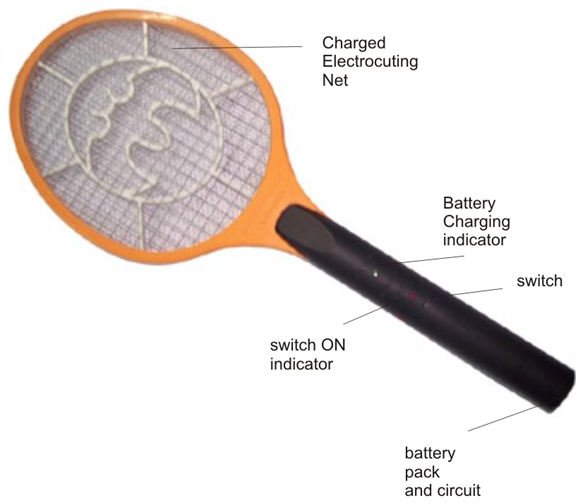
Parts:
1. Power Supply
2. Oscillator
3. Transformer(Step-up)
4, Final mesh-nets
The circuit consists of a flyback topology transformer driven by a general NPN transistor 2SD965.
The feedback coil of transformer is of 10 turns, the primary is of 40 turns and the output or secondary coil is of 450 turns (40:450).
When this circuit is run by giving input of 3 Volts, the transformer generates about 2000-4000 volts at zero load, and the output is then coupled 3 times by using three IN4007 diodes and suitable capacitors, thus reaching our need of 5000-10,000 volts.

The moment a mosquito or any bug comes in contact with the meshes, the stored high voltage in the capacitor discharges violently through the body of the entangled bug creating a big spark and electrocuting it instantly.
Wednesday, November 26, 2014
What are the Advantages of LabVIEW?
- Graphical User Interface
- Drag and Drop built in functions
- Modular and Hierarchical design
- Professional Development Tools
- Multi Platforms
- Flexibility
- Scalability
- Distributed Development
- Visualization capabilities
- Rapid development with Express Technology
- Simple application distribution
- Object oriented design
- Cost Reduction
Thursday, October 09, 2014

Saturday, January 11, 2014

Saturday, December 21, 2013
Mobile Hardware Components

Your Smart Phone was integrated into the followed MOBILE DEVICE COMPONENTS even though your Desktop PC Was not comes with. you must Separately want to plug the components as well as size of the components also big when compared to mobile devices These all are belongs to CMOS VLSI Chip Technology integrated into one device. The Processor and all components are designed as a chip and the Processor was programmed.
Today Quote : "Knowing is not enough, We must Apply Willing is not enough, we must do.."
Introduction to Android Applications (Messengers and VOIP)

Monday, December 02, 2013
Saturday, November 30, 2013
Monday, October 21, 2013
Why Silicon is preferred over Germanium for Semiconductor Devices?
As we all know, both Silicon and Germanium are semiconductor devices. But the present trend is to use Silicon instead of Germanium. What may be the reasons?
 |
- At room temperature, Silicon crystal has fewer free electrons than Germanium crystal. This implies that silicon will have much smaller Collector cut off current than Germanium.
- The variation of Collector cut off current with temperature is less in Silicon compared to Germanium.
- The structure of Germanium crystals will be destroyed at higher temperature. However, Silicon crystals are not easily damaged by excess heat.
- Peak Inverse Voltage ratings of Silicon diodes are greater than Germanium diodes.
- Si is less expensive due to the greater abundance of element. The major raw material for Si wafer fabrication is sand and there is lots of sand available in nature.
But there is a disadvantage for Silicon over Germanium.
The potential Barrier of Silicon is more compared to Germanium.
But if we consider the advantages listed above, we can conclude that Silicon is the best element for the Semiconductor Devices and Applications.
However, the first transistor was made of germanium (Ge). :)
Sunday, March 17, 2013
MAGNETIC RESONANCE IMAGING
Magnetic Resonance Imaging (MRI), nuclear magnetic resonance imaging (NMRI), or magnetic resonance tomography (MRT) is a medical imaging technique used in radiology to visualize internal structures of the body in detail. MRI makes use of the property of nuclear magnetic resonance (NMR) to image nuclei of atoms inside the body.
An MRI scanner is a device in which the patient lies within a large, powerful magnet where the magnetic field is used to align the magnetization of some atomic nuclei in the body, and radio frequency magnetic fields are applied to systematically alter the alignment of this magnetization. This causes the nuclei to produce a rotating magnetic field detectable by the scanner—and this information is recorded to construct an image of the scanned area of the body. Magnetic field gradients cause nuclei at different locations to precess at different speeds, which allows spatial information to be recovered using Fourier analysis of the measured signal. By using gradients in different directions, 2D images or 3D volumes can be obtained in any arbitrary orientation.
MRI provides good contrast between the different soft tissues of the body, which makes it especially useful in imaging the brain, muscles, the heart, and cancers compared with other medical imaging techniques such ascomputed tomography (CT) or X-rays. Unlike CT scans or traditional X-rays, MRI does not use ionizing radiation.
How MRI works
MRI machines make use of the fact that body tissue contains lots of water, and hence protons which get aligned in a large magnetic field. Each water molecule has two hydrogen nuclei or protons. When a person is inside the powerful magnetic field of the scanner, the average magnetic moment of many protons becomes aligned with the direction of the field. A radio frequency current is briefly turned on, producing a varying electromagnetic field. This electromagnetic field has just the right frequency, known as the resonance frequency, to be absorbed and flip the spin of the protons in the magnetic field. After the electromagnetic field is turned off, the spins of the protons return to thermodynamic equilibrium and the bulk magnetization becomes re-aligned with the static magnetic field. During this relaxation, a radio frequency signal is generated, which can be measured with receiver coils.
Information about the origin of the signal in 3D space can be learned by applying additional magnetic fields during the scan. These additional magnetic fields can be used to only generate detectable signal from specific locations in the body (spatial excitation) and/or to make magnetization at different spatial locations precess at different frequencies, which enables k-space encoding of spatial information. The 3D images obtained in MRI can be rotated along arbitrary orientations and manipulated by the doctor to be better able to detect tiny changes of structures within the body. These fields, generated by passing electric currents through gradient coils, make the magnetic field strength vary depending on the position within the magnet. Because this makes the frequency of the released radio signal also dependent on its origin in a predictable manner, the distribution of protons in the body can be mathematically recovered from the signal, typically by the use of the inverse Fourier transform.
Protons in different tissues return to their equilibrium state at different relaxation rates. Different tissue variables, including spin density, T1 and T2 relaxation times, and flow and spectral shifts can be used to construct images. By changing the settings on the scanner, this effect is used to create contrast between different types of body tissue or between other properties, as in fMRI and diffusion MRI.

MRI is used to image every part of the body, and is particularly useful for tissues with many hydrogen nuclei and little density contrast, such as the brain, muscle, connective tissue and most tumors.
Subscribe to:
Posts (Atom)