The python implementation, mathematical background, and noise removal using Fourier Transform are explored in this VIDEO..
Showing posts with label Animation of physics. Show all posts
Showing posts with label Animation of physics. Show all posts
Sunday, May 16, 2021


Monday, May 10, 2021
Basics of Fourier Transform
Tuesday, November 20, 2012
Energy levels and radiations-Animation
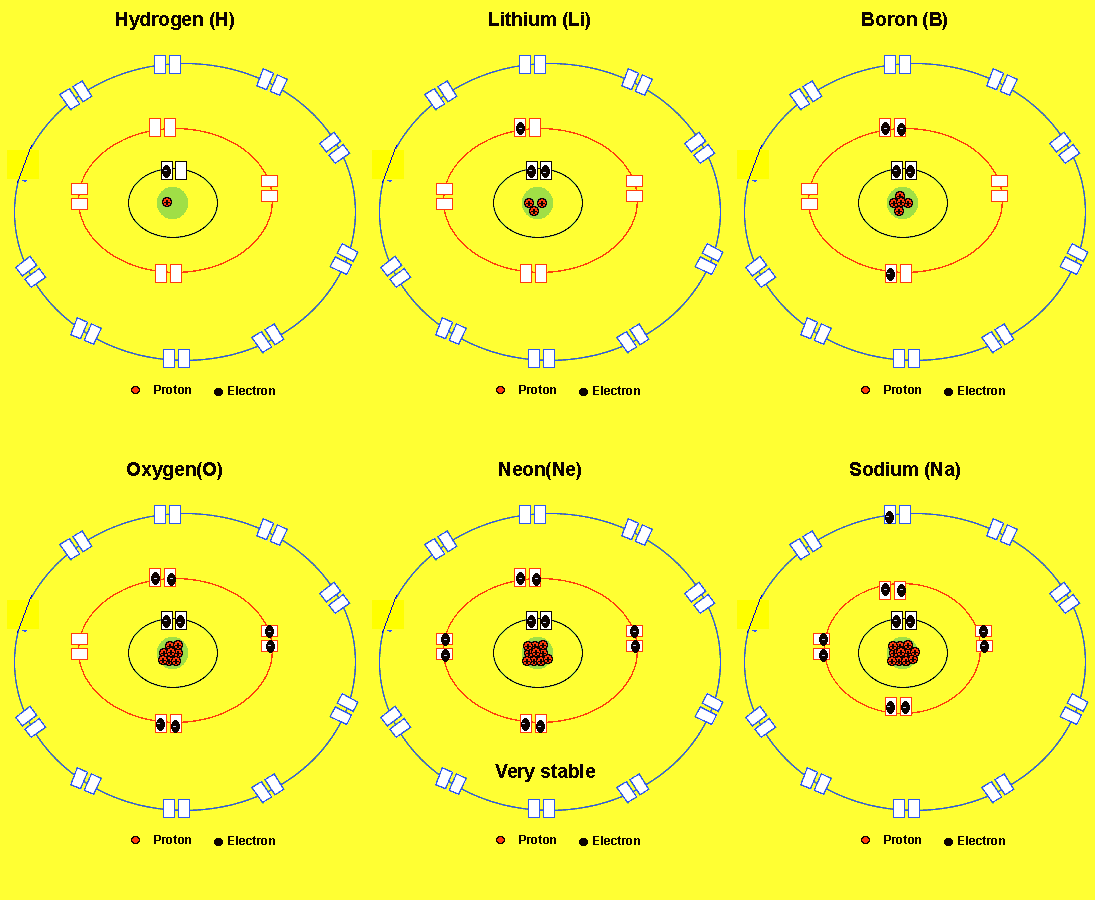
Electrons in a hydrogen atom must be in one of the allowed energy levels. If an electron is in the first energy level, it must have exactly -13.6 eV of energy. If it is in the second energy level, it must have -3.4 eV of energy. An electron in a hydrogen atom cannot have -9 eV, -8 eV or any other value in between.
Let's say the electron wants to jump from the first energy level, n = 1, to the second energy level n = 2. The second energy level has higher energy than the first, so to move from n = 1 to n = 2, the electron needs to gain energy. It needs to gain (-3.4) - (-13.6) = 10.2 eV of energy to make it up to the second energy level.
The electron can gain the energy it needs by absorbing light. If the electron jumps from the second energy level down to the first energy level, it must give off some energy by emitting light. The atom absorbs or emits light in discrete packets called photons, and each photon has a definite energy. Only a photon with an energy of exactly 10.2 eV can be absorbed or emitted when the electron jumps between the n = 1 and n = 2 energy levels.
The energy that a photon carries depends on its wavelength. Since the photons absorbed or emitted by electrons jumping between the n = 1 and n = 2 energy levels must have exactly 10.2 eV of energy, the light absorbed or emitted must have a definite wavelength. This wavelength can be found from the equation
E = hc/l,
where E is the energy of the photon (in eV), h is Planck's constant (4.14 x 10⁻¹⁵ eV s) and c is the speed of light (3 x 10⁸ m/s). Rearranging this equation to find the wavelength gives
l = hc/E.
A photon with an energy of 10.2 eV has a wavelength of 1.21 x 10⁻⁷ m, in the ultraviolet part of the spectrum. So when an electron wants to jump from n = 1 to n = 2, it must absorb a photon of ultraviolet light. When an electron drops from n = 2 to n = 1, it emits a photon of ultraviolet light.
The step from the second energy level to the third is much smaller. It takes only 1.89 eV of energy for this jump. It takes even less energy to jump from the third energy level to the fourth, and even less from the fourth to the fifth.
What would happen if the electron gained enough energy to make it all the way to 0eV? The electron would then be free of the hydrogen atom. The atom would be missing an electron, and would become a hydrogen ion.
Click below to view the animation
Energy level animation
Hardwork Can Never Ever Fails.
Best luck..
Monday, September 24, 2012
Basics of Physics
CENTRIPETAL ACCELERATION
Animation on centripetal acceleration
PROJECTILE MOTION
Animation on projectile motion
PROJECTILE RANGE
Animation on projectile range
NEWTON'S CANNON METHOD
Animation on newton's cannon
KEPLER'S LAW
Animation on kepler's law
DOPPLER EFFECT
Animation on Doppler Effect
SHOCK WAVES
Animation on Shock Waves
All The Best.........
Animation on centripetal acceleration
PROJECTILE MOTION
Animation on projectile motion
PROJECTILE RANGE
Animation on projectile range
NEWTON'S CANNON METHOD
Animation on newton's cannon
KEPLER'S LAW
Animation on kepler's law
DOPPLER EFFECT
Animation on Doppler Effect
SHOCK WAVES
Animation on Shock Waves
All The Best.........
Subscribe to:
Posts (Atom)